


Suitable for confined spaces
Reduces risk in environments with limited escape routes and little space.
Application area
On board ships, limited escape routes, salty ambient conditions and many combustible materials come together — a particularly sensitive environment for lithium batteries.
Starting point
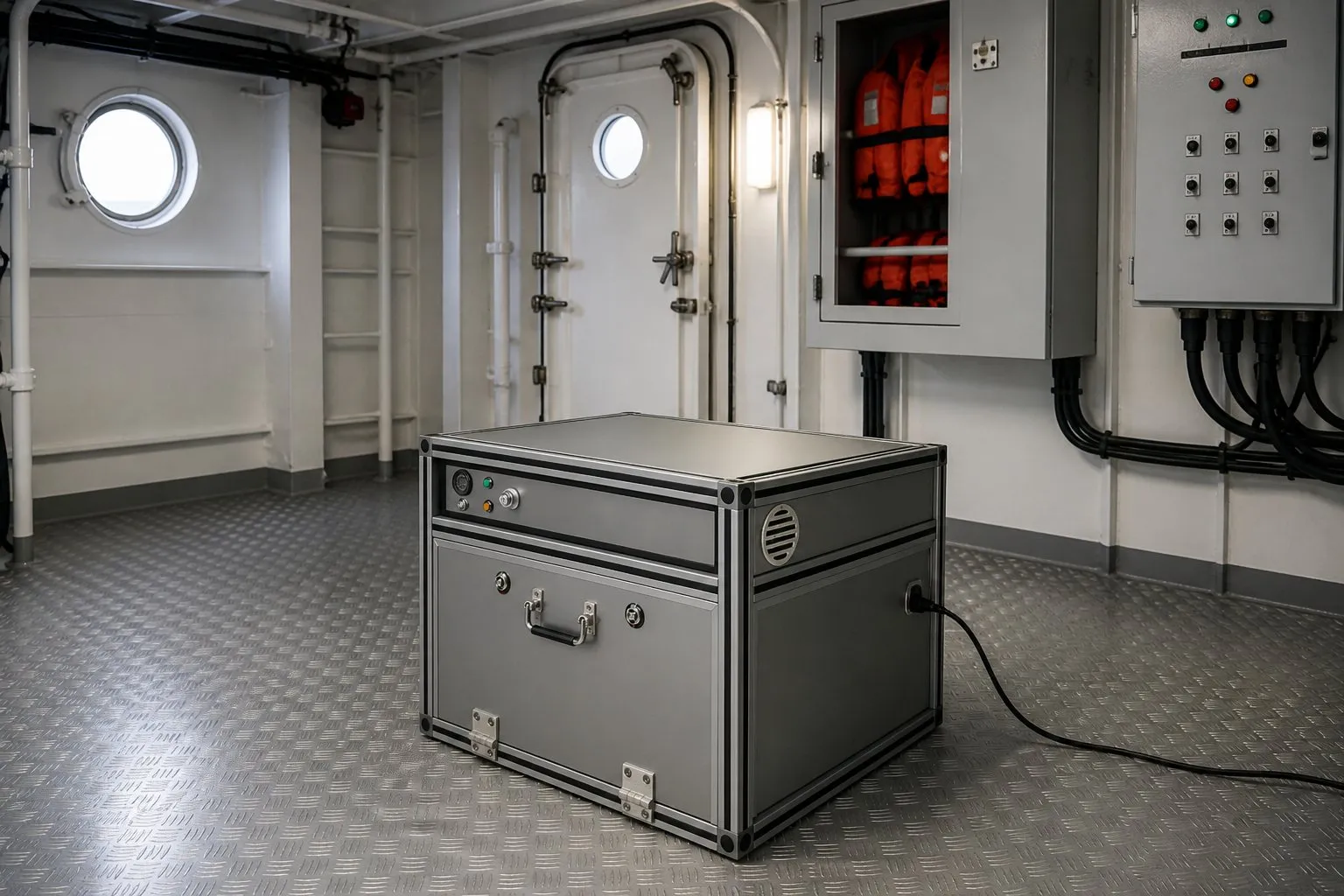
Communication, navigation and rescue equipment is increasingly battery-powered. The Li-Ion Safety Box complements operational fire protection on board with an independent, enclosed module.
On board, one condition applies that does not exist on land: a space cannot simply be left, and outside help may be hours away. Escape routes are limited, and the crew has to handle every incident themselves at first.
At the same time the equipment is increasingly battery-powered — handheld radios, navigation and communication kit, hand lamps, the engine crew's cordless tools, equipment on the life-saving appliances.
Then the environment: salt air and moisture stress cells and contacts, spaces are tight, and cabins, technical rooms and stores hold a lot of combustible material. Charging still happens wherever a socket is free.
Discuss your use caseLocations
How it works
The box is fixed on board in workshop, technical or crew areas — built to take vibration and sea motion.
Batteries for communication, navigation and rescue equipment are charged in one protected place.
IP54 reliably protects charging from moisture and salty sea air.
With no outside help at hand, the system detects and limits critical states by itself inside the closed interior.
Benefits
Reduces risk in environments with limited escape routes and little space.
Complements existing extinguishing systems on board with a standalone protection module.
IP54 protection rating for use in humid, salty conditions.
Protects communication and navigation technology from consequential damage.
In detail
| Typical situation | Risk without protection | With the RUK Li-Ion Safety Box |
|---|---|---|
| Limited escape routes and spaces on board | A fire can spread quickly in confined ship spaces | Enclosed system locally contains flames and heat |
| Charging points for communication and navigation technology | Failure of safety-relevant technology in the event of an incident | Protected charging point reduces the risk of failure |
| Spare batteries for rescue equipment on board | Unclear storage conditions with changing crews | Fixed, controlled storage location |
| High humidity and salty environment | Increased material stress on charging equipment | IP54 protection rating for use in demanding environments |
| Crew areas with private charging equipment from different sources | Chargers and batteries people bring rarely meet one safety standard | A central, controlled charging place for the crew's private devices as well |
| Long voyages with no shore infrastructure and no specialist staff | In an incident, outside help is a long time away | A system that works on its own and reacts without outside support |
More application areas

Protection in manufacturing, assembly and technical areas with heavy use of lithium batteries.
View details
Safe charging and storage in the warehouse, in shipping and in in-house logistics.
View details
Reliable protection in public authorities, schools, universities and other public buildings.
View detailsWe'll advise you on installation location, capacities and integrating the Li-Ion Safety Box into your operation.