
Protection of high inventory values
Stock in the immediate vicinity of charging points remains better protected in the event of an incident.
Application area
Handheld scanners, delivery vehicles and mobile scanning devices often charge unattended in warehouses — frequently overnight, right in the middle of high-value inventory.
Starting point
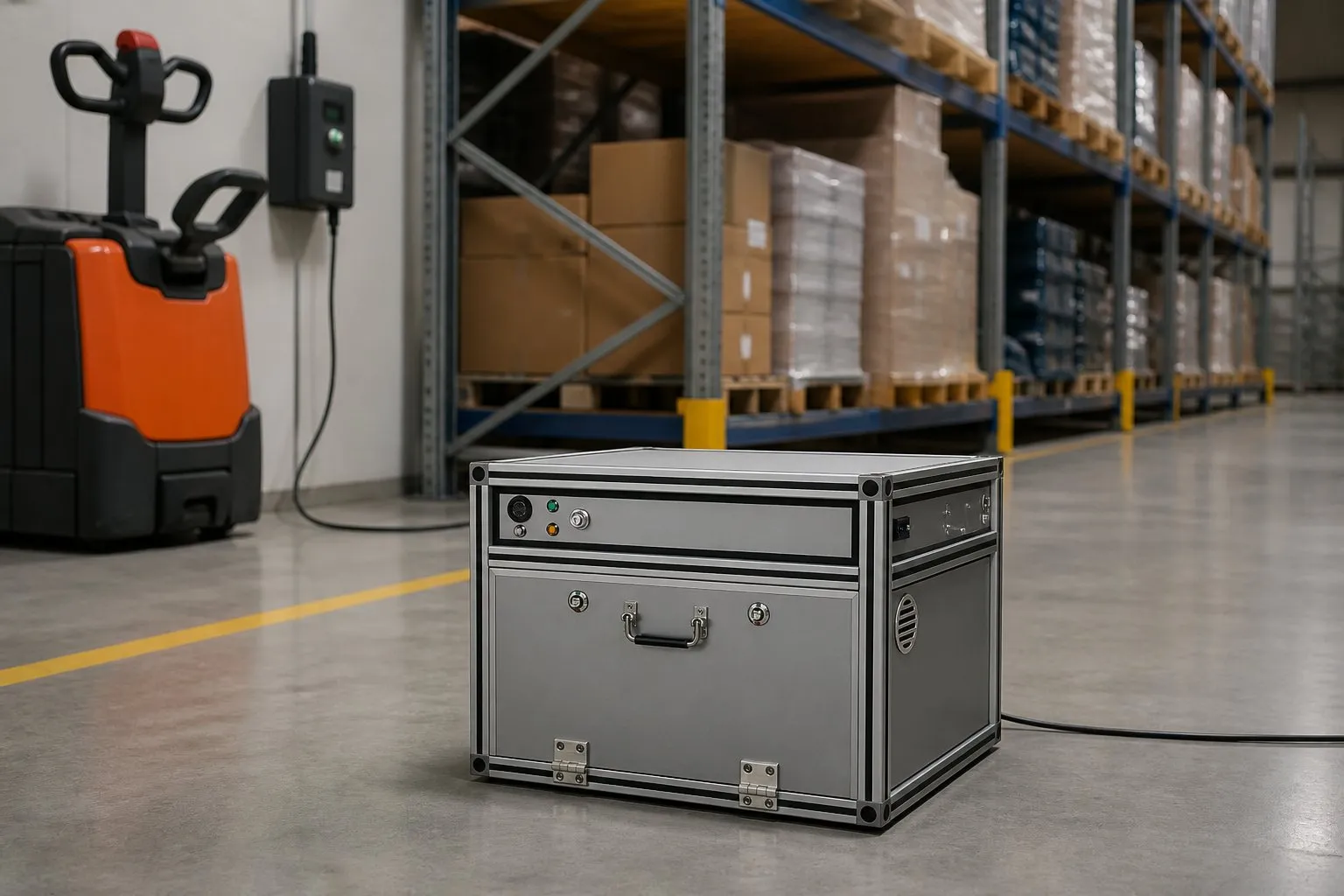
In logistics in particular, high product density meets many different battery types and frequently changing staff. A single incident can quickly turn into major damage.
A warehouse runs on devices that are moving all day: handheld scanners, mobile data terminals, headsets for pick-by-voice, plus spare batteries for industrial-truck accessories. All of it has to be full again between shifts.
The charging places therefore appear where the devices are handed in — at the end of the aisle, in dispatch, next to the packing table. Around them stand cardboard, film and pallets. Those are among the highest fire loads in the operation — and the charging place sits in the middle of them.
At night this continues without supervision. At order peaks, seasonal staff arrive at short notice and do not know the routines. And charging areas for e-bike or e-scooter delivery fleets usually sit at the edge of the site — organisationally often nobody's responsibility.
Discuss your use caseLocations
How it works
The box is fitted into existing rack aisles, picking or shipping areas — with no building work on the warehouse.
Handheld scanners, headset and accessory batteries, or individual e-bike batteries, are placed inside within the limit of 2.2 kWh for Box S and 3.6 kWh for Box M and charged through the four internal sockets. Size L is currently being researched and developed.
Temperature and condition monitoring run continuously — also on night shifts or in automated processes with nobody on site.
At critical values the system reacts on its own, before an incident can spread to stock nearby.
Benefits
Stock in the immediate vicinity of charging points remains better protected in the event of an incident.
Automatic monitoring and extinguishing work even when no staff are on site.
Creates a clearly defined, controlled charging point in open warehouses.
Can be added to existing warehouse logistics without structural changes.
In detail
| Typical situation | Risk without protection | With the RUK Li-Ion Safety Box |
|---|---|---|
| Scanners and devices charge overnight with no staff on site | A fire can go unnoticed for a long time; flames and smoke spread through warehouse racking | Automatic detection and extinguishing — even without staff present |
| High inventory values close to the charging points | A fire risks major material damage to stock | Containment of flames and heat within the enclosed system |
| Many different battery types in circulation | Confusing risk situation, batteries are hard to separate | Separate, controlled charging point for critical batteries |
| E-bikes and delivery vehicles charge at the edge of the warehouse | The charging area is often not a fixed part of the fire protection concept | Defined, secured charging point with its own extinguishing system |
| Seasonal peaks with extra staff at short notice | New, barely trained staff often do not know the charging process or the risks | A self-explanatory, clearly marked charging place with a key switch |
| Picking areas right next to charging points for industrial-truck batteries | Tight space between the flow of goods and the charging setup | A compact, clearly bounded box that fits into existing rack aisles |
More application areas

Protection in manufacturing, assembly and technical areas with heavy use of lithium batteries.
View details
Reliable protection in public authorities, schools, universities and other public buildings.
View details
Safe charging and storage on construction sites and in containers — even in rough conditions.
View detailsWe'll advise you on installation location, capacities and integrating the Li-Ion Safety Box into your operation.