
Accounts for increased protection needs
Specifically reduces risks where public traffic and vulnerable people come together.
Application area
Clinics, authorities, schools and other public institutions have particularly high fire protection requirements due to public traffic and vulnerable people.
Starting point
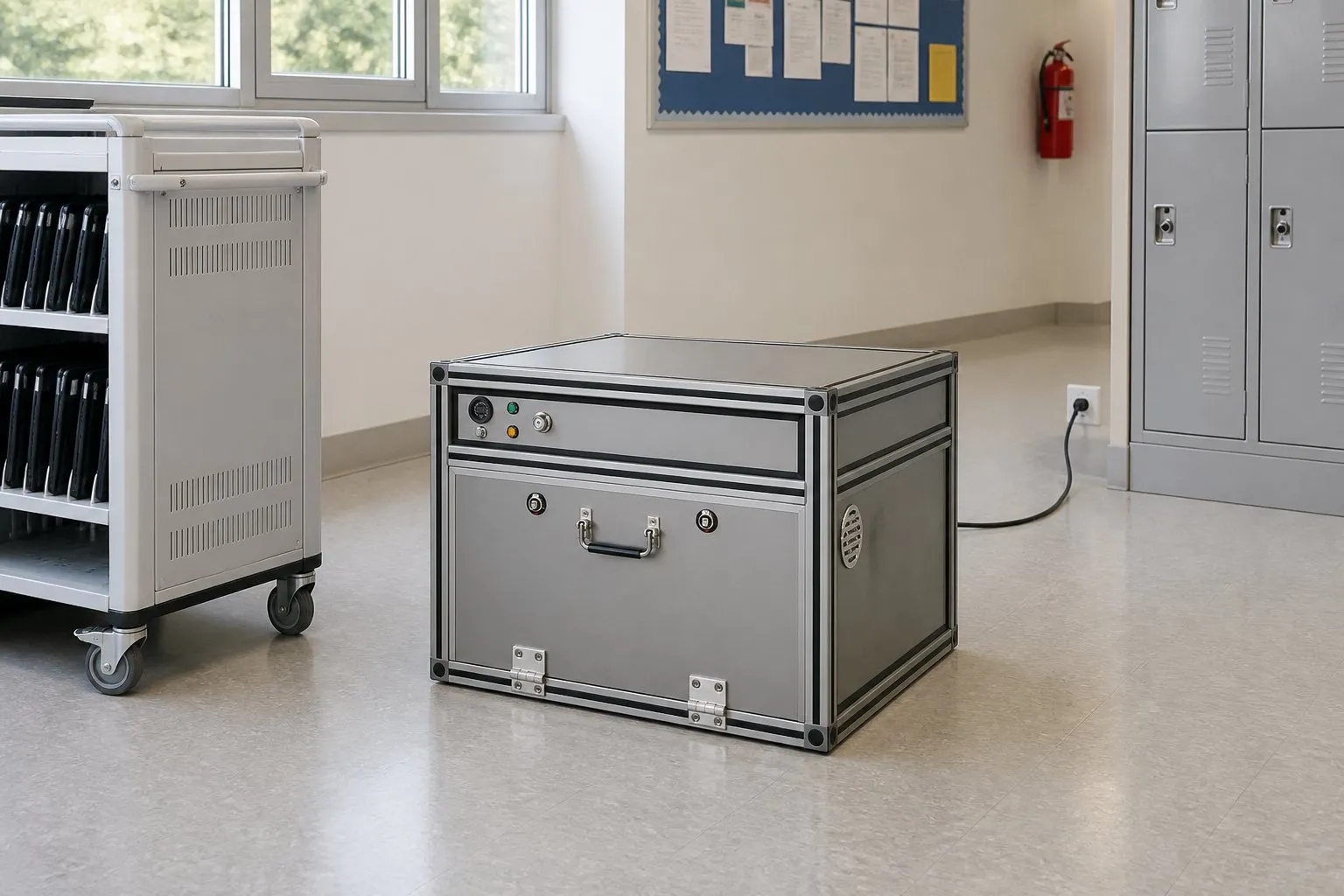
Charging trolleys for tablets, mobile measuring devices in laboratories or service vehicle batteries — the number of lithium-ion batteries in public institutions is also steadily rising, often without fire protection growing alongside it.
Digitising public buildings has a consequence that is rarely talked about: there are a great many batteries in the building. A class set of tablets means thirty cells in a charging cart that stands in the media room in the evening.
Then there are mobile measuring devices in laboratories, devices on hospital wards, loan devices in libraries and the service-fleet e-bikes in the courtyard. They are bought over years and across different budgets — a shared safety concept for charging practically never appears.
At the same time, evacuation here is especially demanding: high occupancy, some people who need protection, limited escape-route capacity. And upgrading the structural fire protection is often simply not possible in existing or listed buildings.
Discuss your use caseLocations
How it works
The box is put where devices are actually charged — in the media room, an office corridor or a ward room — with no building work.
Tablets, laptops, fleet or lab batteries are charged in one fixed, controlled place instead of in open charging trolleys or cabinets.
A key switch decides who may open the box and put devices in — important where the users keep changing.
Temperature sensors detect critical states early and start countermeasures — that lowers the chance an incident escalates to an evacuation.
Benefits
Specifically reduces risks where public traffic and vulnerable people come together.
Early containment reduces the likelihood of larger evacuations in sensitive areas.
Adds a targeted module for batteries to existing fire protection concepts of public buildings.
Can also be integrated into existing or listed buildings without structural changes.
In detail
| Typical situation | Risk without protection | With the RUK Li-Ion Safety Box |
|---|---|---|
| Charging trolleys for tablets/laptops in schools or clinics | High number of batteries in a confined space, often near public traffic | Controlled charging with monitoring instead of open charging trolleys |
| Buildings with high occupant density (clinics, offices) | An evacuation in the event of fire is particularly critical and complex | Early containment significantly reduces the risk of escalation |
| Sensitive areas without continuous supervision | Incidents are noticed late | Automatic response — regardless of whether staff are on site |
| Listed or structurally sensitive buildings | Retrofitting structural fire protection is often difficult or undesirable | Standalone system that can be retrofitted without structural changes |
| Schools and universities with class sets of tablets and laptops | Many batteries charging at once in classrooms or media rooms | One closed group charging place instead of an open charging cart in the classroom |
| Administration buildings with their own service fleet (e-bike, e-scooter) | Charging places for service fleets are rarely part of the building-wide fire concept | A separate, clearly marked charging area for service-fleet batteries |
More application areas

Protection in manufacturing, assembly and technical areas with heavy use of lithium batteries.
View details
Safe charging and storage in the warehouse, in shipping and in in-house logistics.
View details
Safe charging and storage on construction sites and in containers — even in rough conditions.
View detailsWe'll advise you on installation location, capacities and integrating the Li-Ion Safety Box into your operation.