
Clearly defined charging point
Instead of improvised charging spots on workbenches, a fixed, controlled area for batteries is created.
Application area
Manufacturing halls, assembly lines and technical areas now run on a wide range of battery-powered tools and devices. The Li-Ion Safety Box creates a clearly defined, monitored charging point instead of improvised solutions on workbenches.
Starting point
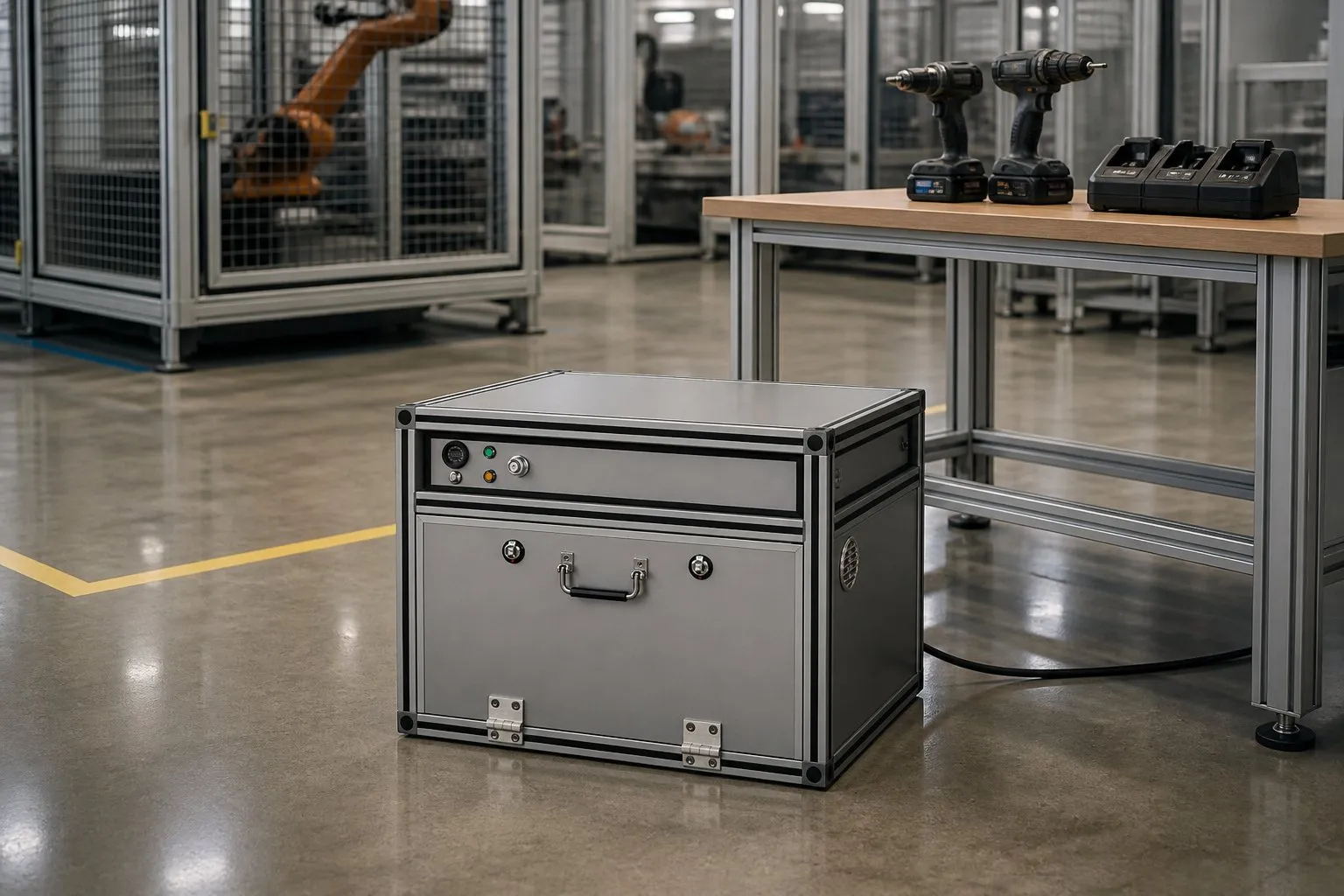
In industry, lithium-ion batteries are mostly charged in a decentralised way — on workbenches, on shelves or directly at the machine. This lack of oversight is exactly what increases the risk in an incident.
The stock of cordless tools in a production plant rarely grows to a plan. A drill here, an impact wrench there, plus the maintenance team's test and measuring devices. After a few years there are two dozen chargers in the plant — spread across workbenches, shelf boards and socket strips at the machine.
Charging happens wherever a socket is free. That is not carelessness. It is what shift work produces: the battery has to be full at the change of shift, so it stays on the charger overnight. By the next morning nobody knows who put it on, or how old it is.
The hall's fire protection concept does not know these charging places. It is designed for the building, the stored goods and the machines — often planned at a time when corded tools were the standard. Between the sprinkler plan and the workbench, that is exactly where a gap in the concept remains.
Discuss your use caseLocations
How it works
The RUK Li-Ion Safety Box is placed at a central, easy-to-reach point in the production hall or workshop — independent of the existing electrical installation.
Tool batteries are placed on the charging surfaces in the closed interior and charged through the built-in sockets.
Sensors inside continuously watch temperature and condition. If something stands out, the system switches off and gives an acoustic warning.
In a critical state the box starts extinguishing, exhaust filtering and pressure relief on its own — without staff having to intervene.
Benefits
Instead of improvised charging spots on workbenches, a fixed, controlled area for batteries is created.
Equipment, tools and shelving in the immediate vicinity remain better protected in the event of an incident.
Early intervention limits damage and reduces the risk of larger production interruptions.
Closes the specific gap that classic hall fire protection concepts often leave around battery charging points.
In detail
| Typical situation | Risk without protection | With the RUK Li-Ion Safety Box |
|---|---|---|
| Tool batteries charge overnight on the workbench | An unattended fire can spread to the workbench, shelving and machinery | Enclosed charging area with monitored charging and automatic extinguishing |
| High battery turnover due to shift operation | Hard to track which battery was charged when and for how long | Fixed, controlled charging point with key switch |
| A visibly damaged battery is charged anyway | Increased risk of thermal runaway | Separate storage and charging of conspicuous batteries outside the production floor |
| The hall's fire protection concept doesn't specifically cover batteries | Gap in operational fire protection at exactly the critical points | Additional, targeted protection module directly at the battery charging point |
| Chargers and accessories from different manufacturers in circulation | Higher complexity and a greater chance of mistakes from mixed accessories | One defined charging place for every cordless-tool type, regardless of manufacturer |
| The maintenance team checks and charges spare batteries for test equipment | Spare batteries stored loose in toolboxes or cupboards | A fixed, documentable place to store and charge spare batteries |
More application areas

Safe charging and storage in the warehouse, in shipping and in in-house logistics.
View details
Reliable protection in public authorities, schools, universities and other public buildings.
View details
Safe charging and storage on construction sites and in containers — even in rough conditions.
View detailsWe'll advise you on installation location, capacities and integrating the Li-Ion Safety Box into your operation.