
Safeguards operational readiness
Reduces the risk of an incident jeopardising the availability of essential response equipment.
Application area
Fire brigades, ambulance services and police depend on permanently ready equipment — and therefore set particularly high standards for their own fire protection.
Starting point
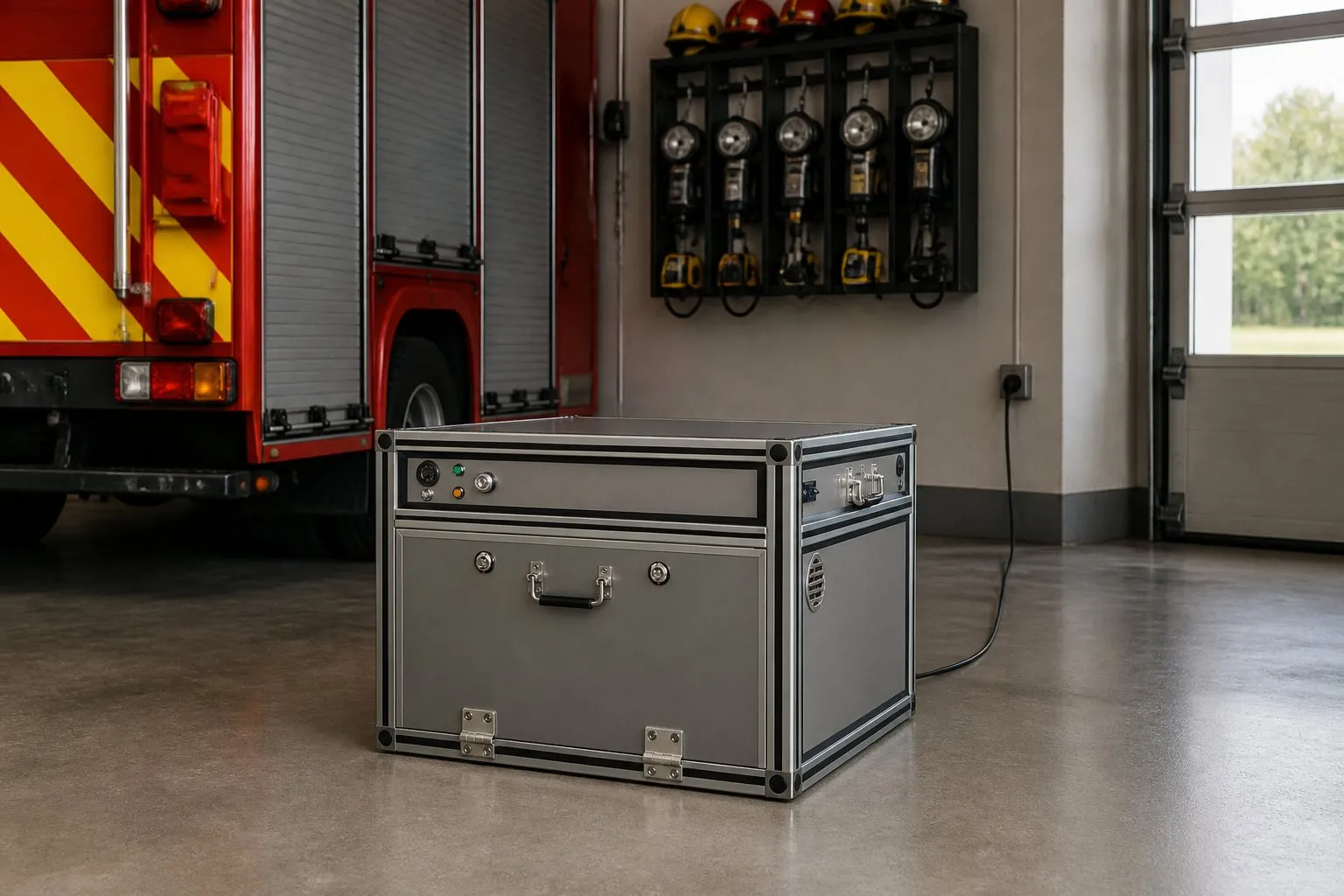
Radios, thermal imaging cameras, drones and lighting equipment often charge at a central but unprotected location at stations. A failure of the charging infrastructure can directly threaten operational readiness.
Almost everything at a station runs on a battery: handheld radios, thermal cameras, lighting sets, drones, measuring equipment, battery-powered rescue tools. The charging places for them have grown over years and usually sit in one central spot, unprotected — often next to the vehicle hall.
The rule is non-negotiable: the equipment has to be ready. So it is charged as soon as it comes back, and it stays on charge. A thorough condition check between calls is not always realistic when the tempo is high and staffing is tight.
And when the alarm sounds, nobody is left in the building. A charge that is already running cannot be watched or stopped during a call. It is unsupervised exactly while the station is empty — a gap many organisations name first themselves.
Discuss your use caseLocations
How it works
The box is set up as a fixed collection point for operational batteries at the station — kept apart from the vehicle hall where that makes sense.
Radio, thermal-camera and drone batteries are charged together in the monitored interior, whatever the device.
Even if the crew suddenly leaves, monitoring and charging continue fully automatically in the background.
Early detection of critical states clearly reduces the risk that essential operational equipment fails.
Benefits
Reduces the risk of an incident jeopardising the availability of essential response equipment.
Protects radio, camera and lighting equipment from consequential damage.
Visibly active self-protection at organisations that are themselves responsible for fire protection.
Suitable for batteries of very different response equipment at one shared, monitored location.
In detail
| Typical situation | Risk without protection | With the RUK Li-Ion Safety Box |
|---|---|---|
| Charging points for response equipment at the station | A failure of the charging infrastructure directly threatens operational readiness | Protected, central charging point reduces the risk of failure |
| Many different battery types (radio, camera, drone, lighting) | Confusing storage makes control more difficult | Central, monitored collection point for response batteries |
| Station with an attached vehicle hall | A fire can spread to response vehicles | Spatial separation of charging point and vehicle hall is possible |
| Own standard of exemplary fire protection | Expectations placed on organisations that fight fires themselves | Visibly active safety concept at your own location |
| Alarm during battery charging at the station | No one can supervise or stop charging when a call comes in | Fully automatic operation that keeps running safely even when the crew is suddenly called out |
| Equipment store with spare batteries for several device types at once | An unclear stock overview makes it harder to have ready batteries quickly | One central, monitored collection point with clearly defined charging places |
More application areas

Protection in manufacturing, assembly and technical areas with heavy use of lithium batteries.
View details
Safe charging and storage in the warehouse, in shipping and in in-house logistics.
View details
Reliable protection in public authorities, schools, universities and other public buildings.
View detailsWe'll advise you on installation location, capacities and integrating the Li-Ion Safety Box into your operation.