
Safe handling of foreign batteries
Reduces risks when handling customer batteries in unknown or damaged condition.
Application area
In car and two-wheeler workshops, foreign, often damaged customer batteries meet combustible operating fluids such as oil, paint and plastics.
Starting point
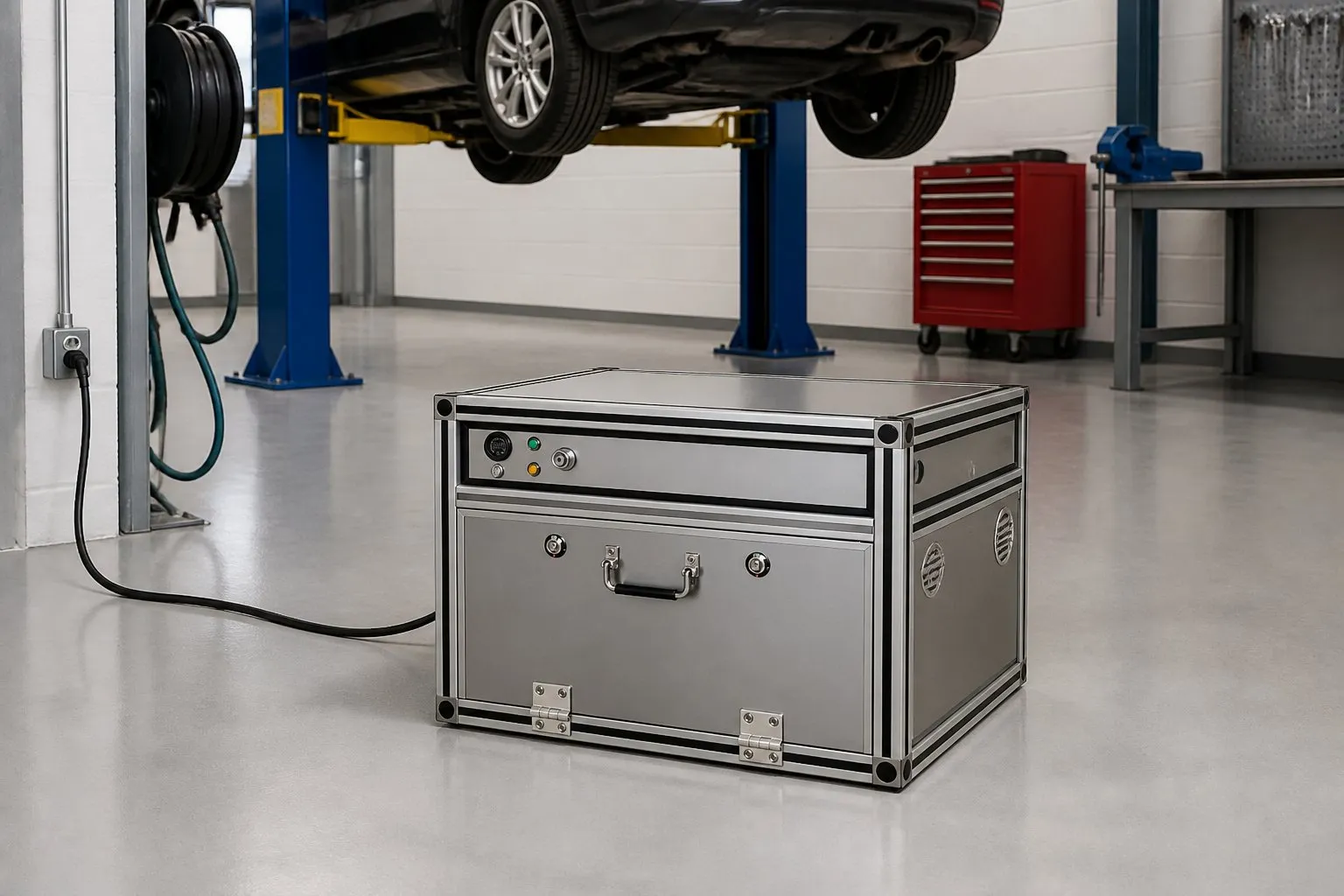
When a customer's battery is connected for diagnosis, its actual condition is rarely obvious at first glance. This is exactly where a protected, monitored testing and charging point adds extra safety.
In the workshop, other people's batteries lie on the bench. A customer brings an e-bike battery because it no longer charges properly — precisely because something is wrong with it.
What happened to the battery before is on no job sheet: a fall, a deep discharge over the winter, someone else's repair, a copy charger. From the outside that is usually invisible, and when it is connected for diagnosis the condition is still unknown.
Around it stands the workshop: oil, brake cleaner, paint, tyres, plastic, plus customers' vehicles on the lift. And charging often runs overnight, because the diagnosis takes time and the customer comes the next day.
Discuss your use caseLocations
How it works
The battery is put into the protected interior for diagnosis or repair, instead of being connected in the open on the bench.
Temperature sensors detect critical values early — also on batteries with unknown or invisible prior damage.
Batteries with visible issues are stored and checked apart from sound ones, away from the workshop floor.
Outside opening hours, automatic monitoring and extinguishing stay active — with no staff present.
Benefits
Reduces risks when handling customer batteries in unknown or damaged condition.
Conspicuous batteries can be stored and tested separately from inconspicuous ones.
Reduces consequential damage to tools, lifts and vehicles in the workshop.
Builds customer trust through a visibly considered approach to battery risks.
In detail
| Typical situation | Risk without protection | With the RUK Li-Ion Safety Box |
|---|---|---|
| A customer battery of unknown condition is connected for diagnosis | Pre-existing damage is often not visible from the outside | Protected test bay with monitored charging and shutdown |
| Workshop with many flammable substances (oil, paint, plastics) | A battery fire can quickly spread to the entire workshop | Containment of flames and combustion gases within the enclosed system |
| Repair of damaged e-bike or power tool batteries | Increased risk due to mechanical pre-damage | Separate storage location for conspicuous batteries away from the workshop floor |
| Charging overnight, outside opening hours | Unsupervised risk after closing time | Automatic response regardless of staff presence |
| Diagnostic and test benches right next to lifts and vehicles | An incident at the test bench can put expensive vehicles and workshop equipment at risk | A clearly separate test and charging place, away from the main workshop floor |
| Talking to customers about battery risks | Customers increasingly expect a visibly safe way of handling e-bike and power-tool batteries | A visible safety concept that builds trust when talking to customers |
More application areas

Protection in manufacturing, assembly and technical areas with heavy use of lithium batteries.
View details
Safe charging and storage in the warehouse, in shipping and in in-house logistics.
View details
Reliable protection in public authorities, schools, universities and other public buildings.
View detailsWe'll advise you on installation location, capacities and integrating the Li-Ion Safety Box into your operation.