


Designed for high-performance batteries
Suitable for cells with high energy density, as typically fitted in drones.
Application area
Drone batteries are among the most powerful and sensitive lithium cells in mobile use — especially after hard landings or crashes.
Starting point
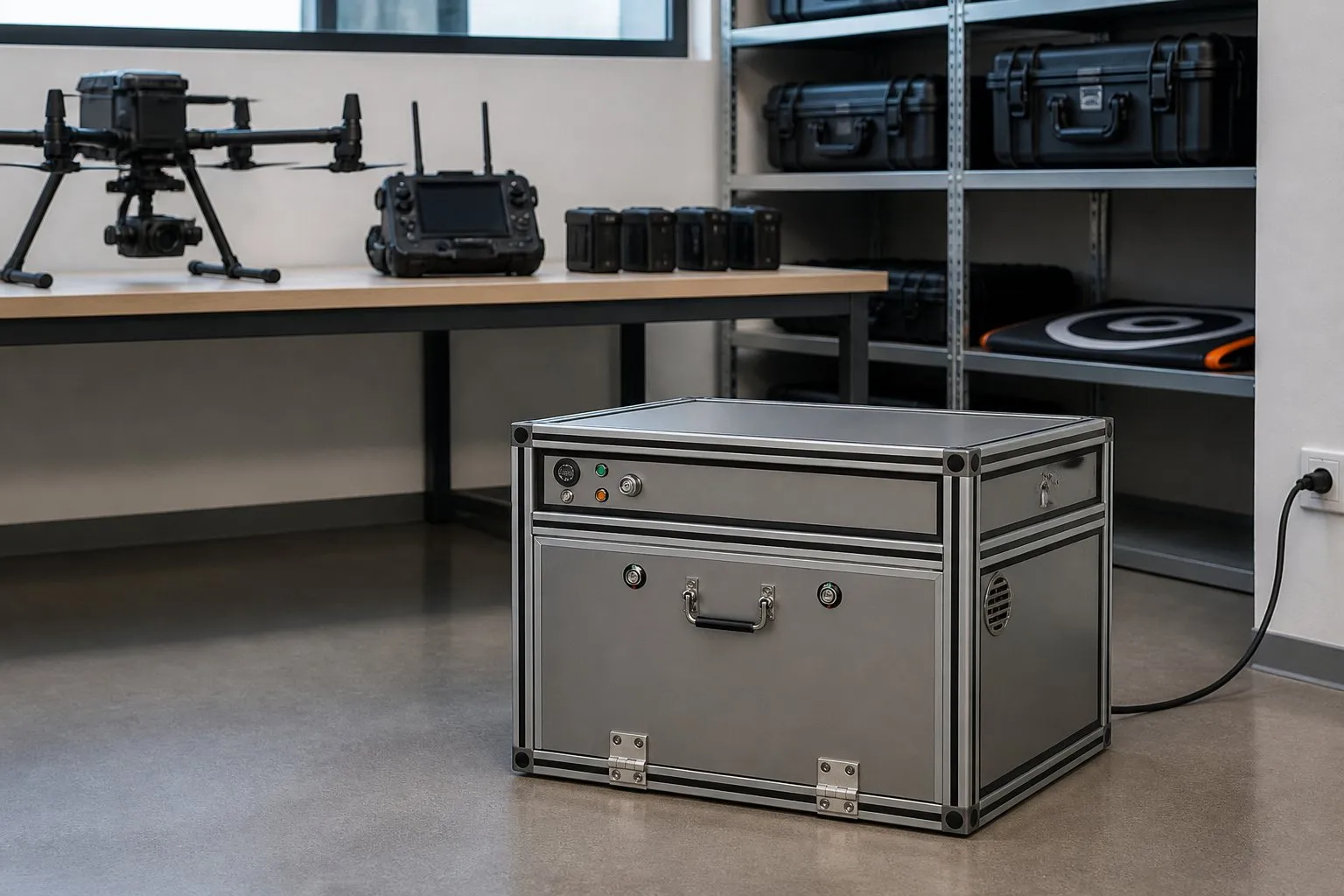
Surveying, inspection and security operations require short charging cycles at a high operating frequency. There is often little time for careful condition checks between missions.
Drone batteries are built for maximum energy density. They are discharged at high current, often put back on charge while still warm from landing, and flown close to the cut-off. That is normal operations — and it is where the cells are stressed the hardest.
Then there is the mechanical history. A hard landing, a touchdown in the field or a crash leaves damage that is not visible from the outside — the cell can become conspicuous hours later.
In surveying, inspection or security work the tempo is high and the charge cycle is short. Charging happens in the vehicle, in the operations container or in the equipment store, right next to the rest of the kit. Between flights there is hardly any time for a careful condition check.
Discuss your use caseLocations
How it works
After every flight — especially after a hard landing or a crash — drone batteries go into the box instead of straight back into use.
Charging runs in the monitored interior, with continuous temperature control for high-energy cells.
Batteries that may be mechanically damaged stay apart from sound ones until their condition is clear.
The box moves with the team to the next site — in the field, in the vehicle or at base — and keeps the same safety standard there.
Benefits
Suitable for cells with high energy density, as typically fitted in drones.
Reduces risks from high operating frequency and short charging cycles.
Suitable for changing deployment locations in the field, in the vehicle or at base.
Enables separate, monitored storage of batteries after hard landings or crashes.
In detail
| Typical situation | Risk without protection | With the RUK Li-Ion Safety Box |
|---|---|---|
| Drone batteries with high energy density in continuous use | Particularly high risk from mechanical pre-damage (crash, hard landing) | Separate, monitored charging point for conspicuous batteries |
| High operating frequency with short charging cycles | Little time for careful condition checks between missions | Automatic monitored charging during charging |
| Changing deployment locations (field, vehicle, base) | Permanent fire protection is usually not available on site | Mobile system for changing locations |
| High-performance batteries for special applications | Higher energy released in a fault scenario | Active containment of flames, heat and pressure |
| Training and operations centres charging several fleet batteries at once | High battery density while several pilots train at the same time | One central, monitored charging point for the whole drone fleet |
| Batteries after a crash or hard landing with no obvious damage | Internal damage is often invisible from the outside and stays unnoticed | A separate observation phase in the monitored interior before the battery is used again |
More application areas

Protection in manufacturing, assembly and technical areas with heavy use of lithium batteries.
View details
Safe charging and storage in the warehouse, in shipping and in in-house logistics.
View details
Reliable protection in public authorities, schools, universities and other public buildings.
View detailsWe'll advise you on installation location, capacities and integrating the Li-Ion Safety Box into your operation.