
Safeguards operational readiness
Reduces the risk of an incident jeopardising the availability of essential response equipment.
Application area
Fire brigades, ambulance services and police depend on permanently ready equipment — and therefore set particularly high standards for their own fire protection.
Starting point
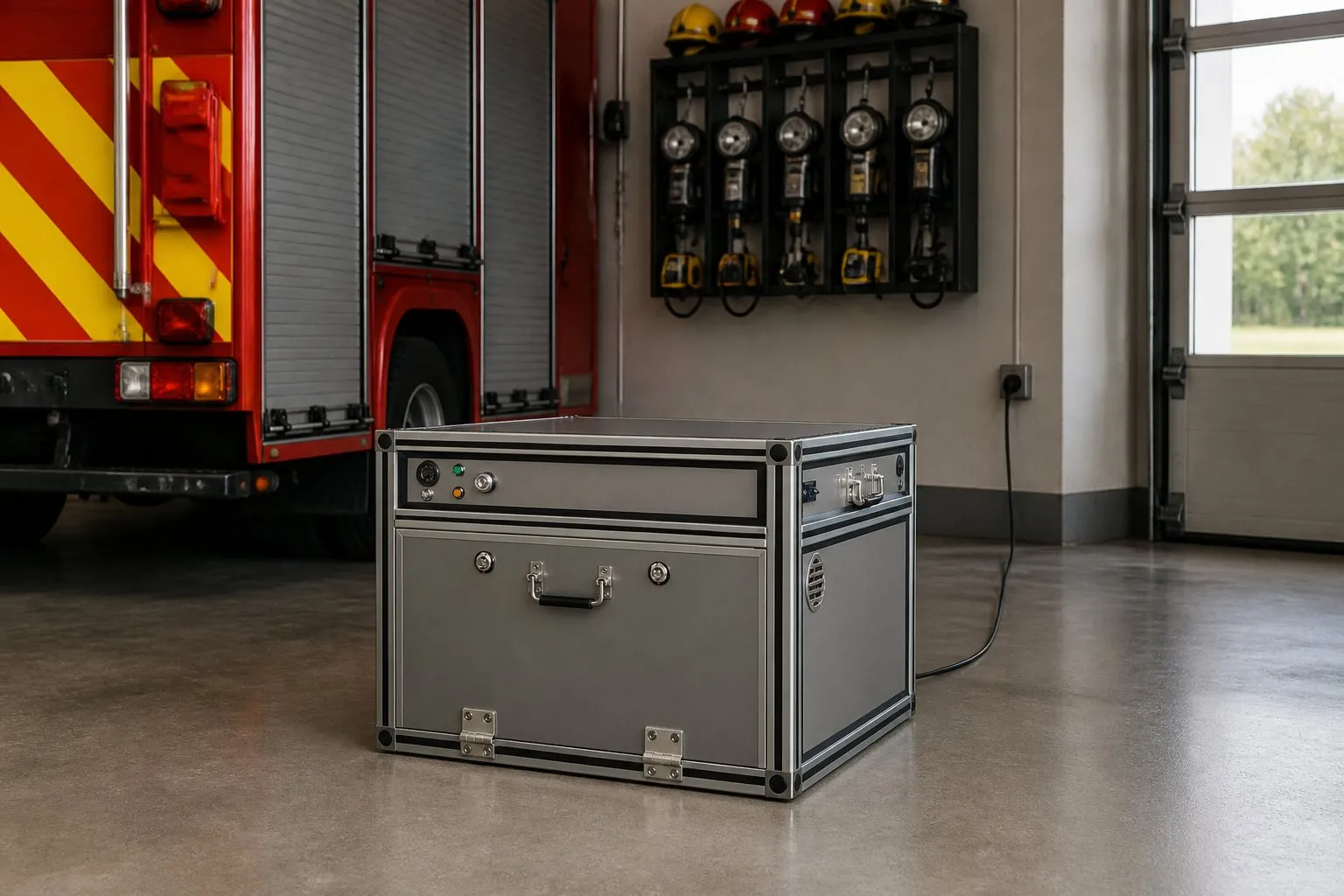
Radios, thermal imaging cameras, drones and lighting equipment often charge at a central but unprotected location at stations. A failure of the charging infrastructure can directly threaten operational readiness.
Discuss your use caseLocations
Benefits
Reduces the risk of an incident jeopardising the availability of essential response equipment.
Protects radio, camera and lighting equipment from consequential damage.
Visibly active self-protection at organisations that are themselves responsible for fire protection.
Suitable for batteries of very different response equipment at one shared, monitored location.
In detail
| Typical situation | Risk without protection | With the Li-Ion Safety Box M fire protection box |
|---|---|---|
| Charging points for response equipment at the station | A failure of the charging infrastructure directly threatens operational readiness | Protected, central charging point reduces the risk of failure |
| Many different battery types (radio, camera, drone, lighting) | Confusing storage makes control more difficult | Central, monitored collection point for response batteries |
| Station with an attached vehicle hall | A fire can spread to response vehicles | Spatial separation of charging point and vehicle hall is possible |
| Own standard of exemplary fire protection | Expectations placed on organisations that fight fires themselves | Visibly active safety concept at your own location |
We'll advise you on installation location, capacities and integrating the Li-Ion Safety Box M into your operation.